
Agritech in Singapore: Achieving Food and Economic Security
Under the "30 by 30" vision, agritech also builds up Singapore's capability and capacity to produce 30% of our nutritional needs by 2030
Last updated 24 November 2025
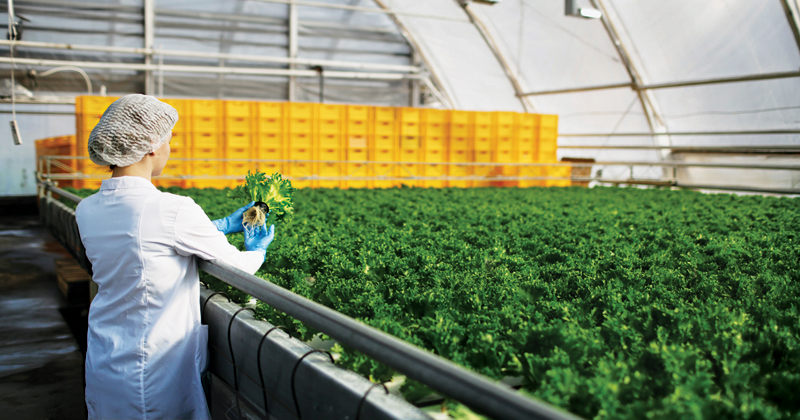
Image: Enterprise Singapore
In the 1960s, farmland occupied 14,000 hectares of land in Singapore. By 1988, this fell 2,037 hectares. Today, 90% of what we eat is imported, and only 1% of our land is available to agriculture.
While this means that Singapore has access to the global market of different types of food, it also exposes Singapore to the “volatilities of the global food market”, as then-Minister for Water, Environment and Resources Masagos Zulkifli said in 2019.
We have too little land to cultivate food meaningfully, no natural resources to enrich ourselves and remain, one of the most water-stressed countries in the world.— Minister for the Environment and Water Resources, Masagos Zulkifli, at the Committee of Supply Debate 2019.
With this in mind, Singapore launched the ‘30 by 30’ vision in 2019. It aimed to produce 30% of the food we consume by 2030.
The ‘30 by 30’ vision may seem daunting then, given that Singapore does not have large tracts of land to support farming activities. However, one way we have overcome these physical limitations is through agri-technology.
The Singapore Food Story 2
As an aspiration only for local production, the '30 by 30' vision was replaced by the Singapore Food Story 2 in November 2025. The Singapore Food Story 2 aimed to bring about overall food resilience in Singapore to ensure sufficient food supply in times of disruption.
Examples of agri-technology in Singapore
One early example is the Lim Chu Kang Agrotechnology Park, which is situated in an area once well-known for its vast plantations. Phase One was built in 1989, and it supported the world's first cultivation of temperate vegetables (such as lettuce) in a tropical climate. This model was replicated in places like Mandai, Nee Soon and Sungei Tengah in phases over time.
Another example is the Marine Aquaculture Centre (MAC), opened in 2003. The centre led to the development of a new breed of sea bass with a shorter incubation time and greater resistance to diseases. In one of its pilot tests, half a million of these fishes were hatched at St. John’s Island, nurtured in Indonesia, and then sent back to Singapore.
In 2019, Singapore invested almost S$250 million into the industry to build up the environment, which saw the blossoming of new agritech solutions, ideas, and concepts through insightful business mentorship.
In spite of supply disruptions caused by border closures due to COVID-19, Singapore continues to build up the local agri-food sector. These include planning for land and infrastructure, supporting ecosystem growth through the adoption of technology and better farming practices, and encouraging support of local produce. One such effort is the $60 million Agri-food Cluster Transformation (ACT) Fund introduced in April 2021 to support local farms in adopting technology and advanced farming systems along the farm-to-fork value chain, which will contribute towards a vibrant agri-food ecosystem.
To complement this effort, the Urban Agriculture Centre of Innovation (UACOI) was launched in October 2022 to focus on key areas of innovation and R&D commercialisation to ensure sustainable agri-technology and practices while supporting the build-up of capabilities for small and medium-sized enterprises in this sector.
In 2025, the North region of Singapore was earmarked in the URA Draft Masterplan 2025 for industrial developments. Specifically, Lim Chu Kang will be re-developed to house local food production and horticulture activities, while the upcoming Sungei Kadut Eco-District is set to support agri-tech industries.
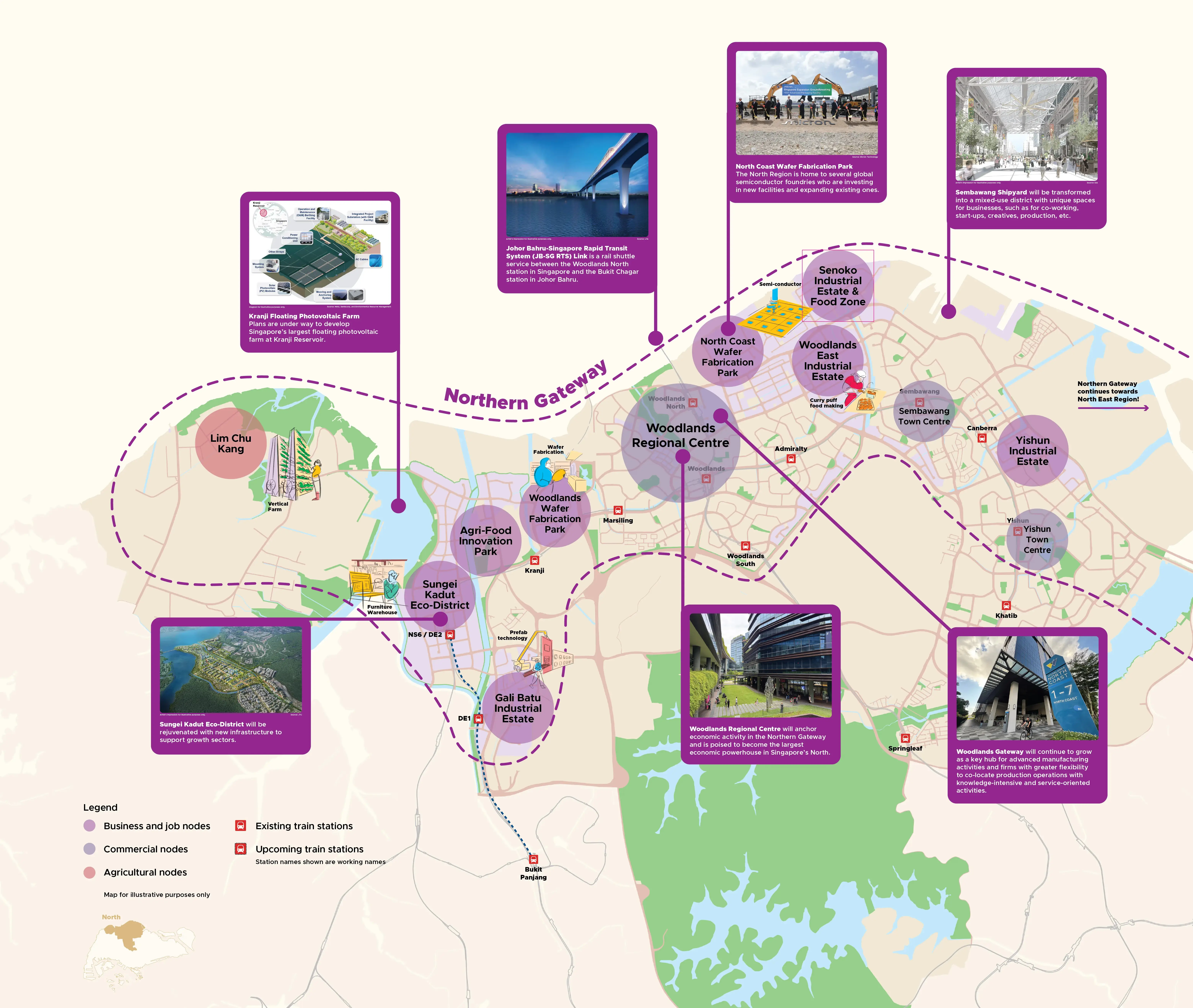
Northern Gateway: powering industry and workspaces. Image: URA Draft Masterplan 2025.
Beyond simply ensuring Singapore’s food security, these efforts are also spurring greater economic activity, such as the agri-tech sector being set to create about 4,700 jobs by 2030, with 7 in 10 roles for professional, managers, executives and technicians (PMETs) or skilled labourers.